
Featured Stories
America’s Safe Schools Week: Safe schools in Kansas depend on partnerships, communication
Oct 22, 2026
by Angela Deines, KSDE Communications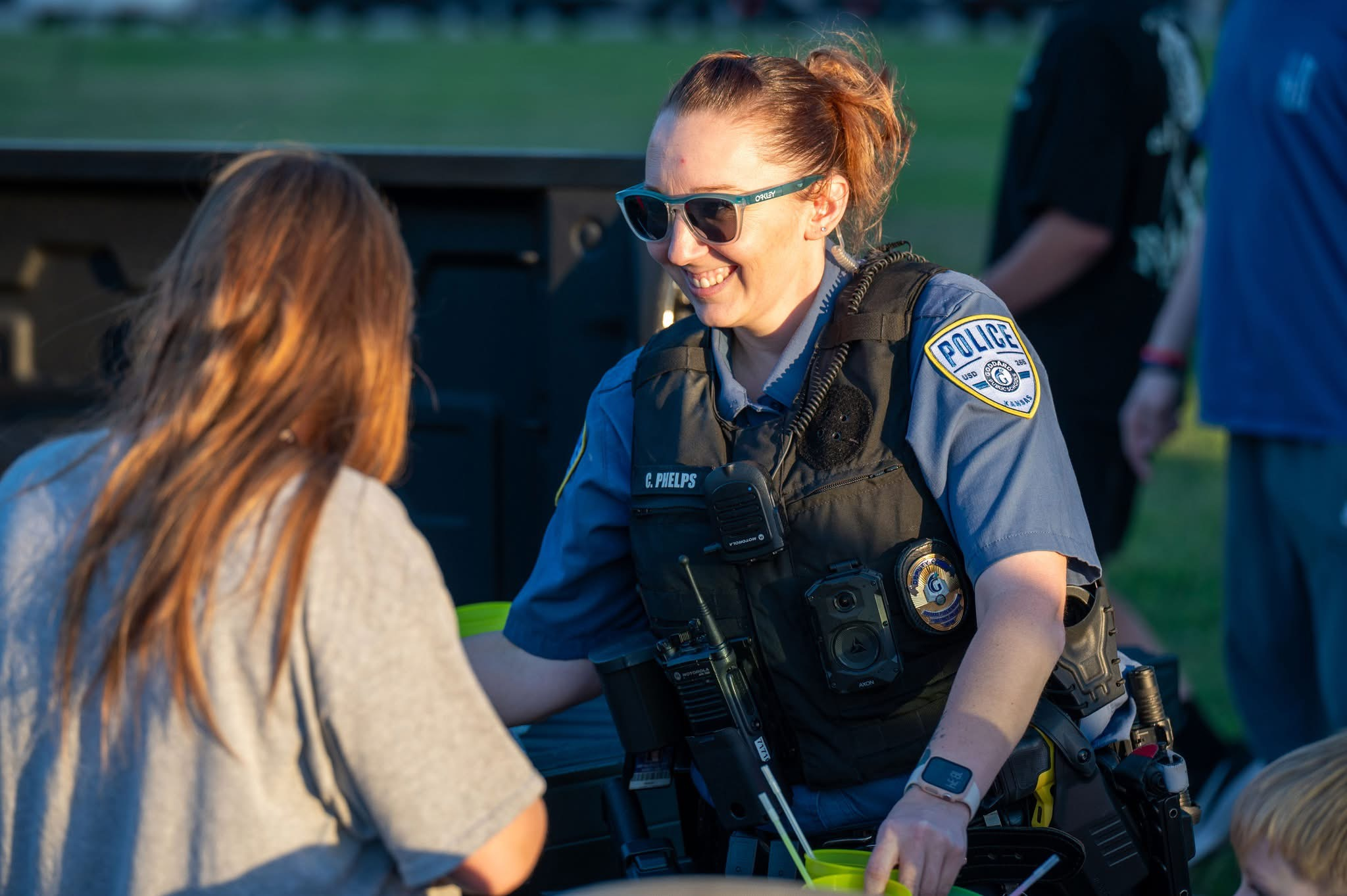
Carrie Phelps, top right, has been a Goddard USD 265 police officer for the past 10 years and currently serves as the district's assistant chief of police. She's pictured here talking with a family at a recent Touch-A-Truck event. (Photo submitted by Carrie Phelps, Goddard USD 265.)
Keeping school buildings secure is a priority for every school community. However, several Kansas school safety professionals agree strong communication and relationships are just as important as physical security measures in keeping students and staff safe.
“At Wichita Public Schools, we invest in building features and systems that enhance safety, while also emphasizing the daily interactions between staff and students,” said Terri Moses, division director of safety and environmental services for Wichita USD 259. “Effective safety depends on both physical safeguards, such as secured entries, and trusted adults who recognize concerns early and help students feel connected and supported.”
A veteran of the Wichita Police Department (WPD) who retired as deputy chief in 2013, Moses said USD 259 provides crisis management services and programs that cover prevention, protection, mitigation, response and recovery. She said the power of partnerships, including those with USD 259 staff, mental health providers, local public safety agencies, the Wichita Metro Crime Commission and the WPD, are key for these crisis management practices to work to keep a school community safe.
“By looking at safety from a point of view that covers everything from prevention to recovery, (we’ve) built a catalog of safety activities that allows us to enhance the safety and belonging we all have at WPS,” Moses said.
Just to west of Wichita in Goddard, Carrie Phelps, assistant chief of police for USD 265, said there is an emphasis on building relationships within the district by prioritizing the visibility of district safety officers in school hallways, classrooms and drop-off and pick-up lines.
“This helps establish our officers as approachable mentors and trusted figures rather than just emergency responders,” she said. “This makes our officers a part of the building level teams.”
Phelps credits Ronny Lieurance, USD 265’s chief of police, for setting the precedent since 1998 that officers “would be in and out of the buildings all the time.”
“This has created a low stress environment that bridges the gap between students and first responders,” she said. “Our agency works hard to become a trusted member of the school. If that is from kids taking brain breaks in our offices, or we schedule mentoring time with those who need a little extra support, we are always known to the students.”
Like Wichita USD 259, Goddard USD 265 partners with the Wichita Metro Crime Commission in using the Speak Up program that allows students, staff, parents and the public to voice confidential concerns about safety, bullying or mental health. Phelps said continuing education is also provided to the district’s officers and staff on safety and security measures to ensure safety standards are consistently followed. She said USD 265 also recently began using specialized mental health resources to offer free, anonymous support, therapist-led webinars and mental health tools for parents and caregivers to access.
“The focus has always been the community and the kids,” Phelps said. “We focus on early intervention methods, removing the stigma around asking for help, and promoting that the schools are a community who support students and families.”
In Dodge City, David Miller, safety and security director for USD 443, uses his experience in local and federal law enforcement, counterterrorism, physical security and intelligence to help make the district’s buildings and spaces as safe and secure as possible. He said several measures have been taken by USD 443 to enforce building access protocols using identification badges, weapon and security notice signage and behavioral threat assessment management training, to name a few.
Miller said two recent facility security assessments done by a member of the Kansas State Department of Education’s (KSDE) safe and secure schools team were valuable.
“Walking through the process with KSDE, coupled with my previous experience, has enabled me to conduct them internally, which is beneficial,” he said.
Safety and security are a “constant effort” and “communication is key,” Miller said. He said professionals in USD 443 administration, local law enforcement, security and physical and mental health providers are working as a cohesive team, ensuring “we can be more effective in achieving the best outcome for all.”
“The best-case scenario is to be in the background doing what needs to be done to ensure an environment where students can focus on their academics and positive social interaction with an engaged staff,” Miller said.
KSDE safe and secure schools resources
During America’s Safe Schools Week, Oct. 19 – 23, districts and schools have been encouraged to educate, empower, and engage their school communities to make safety a priority.
With that in mind, John Calvert and Ben Thursby of the Kansas State Department of Education’s safe and secure schools team asked districts and schools to focus this week on their emergency operation plans (EOP), student mental health, safety drills, information about safety hotlines, suspicious activity reporting (SAR) and behavioral threat assessment management (Contact Calvert, john.calvert@ksde.gov, for more informaiton).
Calvert said he and Thursby are available to assist districts with safety information and resources, including school building safety assessments.
“Anything school safety-wise, anytime, we will make it work, whether in-person or virtually,” he said. “We also have a school safety summit during the annual Great Ideas in Education Conference, and we push information out on our listservs about the best practices to help keep our schools safe.”
Calvert said he regularly emphasizes that while keeping students and staff safe in and around schools is of the upmost priority, fostering communication and connections is what builds and maintains a culture of safety.
“The number one thing we emphasize is the importance of building positive and appropriate relationships,” he said.
Kansas House Bill 2534
Calvert said district safety professionals and administrators are still getting up to speed on the requirements of Kansas House Bill 2534, the Students Safe at School Act, that became law during the 2026 legislative session. It includes the parameters of active shooter drills and simulations in school environments, which are not mandatory.
“Considerations for Active Shooter Drills,” is a KSDE document that “provides best practice considerations to support safe, developmentally appropriate, and trauma-informed decision-making when such drills are considered or implemented. School districts should use current research and nationally recognized best practices to help keep students physically and psychologically safe.”
2027 Safe and Supportive Schools conference call for presenters
The 2027 Kansas Safe and Supportive Schools conference will be April 1-2, in Wichita. The KSDE safe and secure schools team is seeking presenters who can share their expertise and practical strategies that can be implemented in school communities, creating safe and supportive learning environments.
The call for presenters application closes Dec. 1. Acceptance notifications will be sent by Jan. 1.
Contact Ben Thursby, ben.thursby@ksde.gov, John Calvert, john.calvert@ksde.gov, or Chris Fletcher, christopher.fletcher@ksde.gov, with questions.
